Renter-friendly Wi‑Fi that actually covers the flat
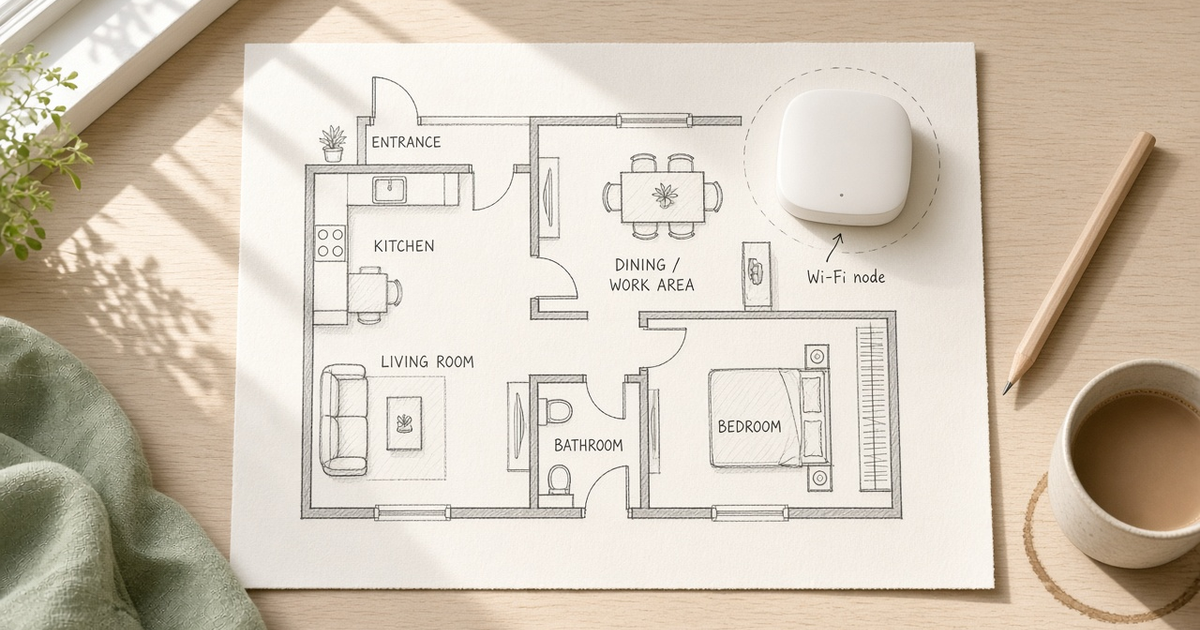
A flat with one dead room does not need another box with a glowing logo. It needs a signal that reaches the room where people actually sit, without holes in the wall the landlord has not agreed to.
Find out whether the line is the problem
If the feed into the flat is already weak, a second router will not invent speed that never arrives. Before you buy anything, check what the address is supposed to get. Ofcom’s coverage and speeds pages are the public place to start, not the speed claim on a shop shelf.
Then stand in the bad room with a phone. Write down which of two failures you have. Either the Wi-Fi name disappears, which is coverage, or the name is there and pages crawl, which is often the broadband itself or too many devices on a tired router. Those are different purchases. Mixing them up is how people end up with three boxes and the same dead corner.
An extender and a mesh kit are not the same thing
An extender repeats whatever it can hear. Park it where the existing signal is already dying and it repeats a weak signal. The room stays poor, and you have added a plug and a password. It only helps when it sits where the signal is still strong, with the dead room just beyond that point.
A mesh kit replaces the single router with two or three nodes that hand a phone from one to the next as you walk. It costs more. It still fails if a node is shut in a cupboard, or if a thick wall sits between the nodes. For a renter the useful test is whether the whole kit goes back in the box when you move, not whether the packaging says “whole home”.
What you can do without asking for a drill
Move the router off the floor, and away from the microwave, the television and any metal cabinet. A hallway socket, if you can spare it, often covers more rooms than a corner of the living room behind the sofa.
If the router that came with the contract is old, ask the provider to replace it before you buy your own. You are already paying for the line. Making them fix their end is cheaper than a stack of boxes you will have to remove at the end of the tenancy.
Do not drill, do not screw a node into plaster, and do not run cable across a finish you would have to make good. A node on a shelf and a router on a table leave nothing behind when you leave. If the tenancy is silent on alterations, silence is not permission.
When to stop
Stop when a second box has not changed the room you cared about. At that point the limit is the building or the line, and another purchase is a drawer of adaptors. If a kit does not do what you bought it to do, your consumer rights cover faulty goods. Use them, then put the money into the broadband contract instead of a third box.
Related: kitchen gadgets that earn the counter, which uses the same test. Does it earn the space, and can you send it back?