How to read a product privacy page before you click Accept
A privacy page is the document that is supposed to tell you who gets your data and why. Most people click Accept because the page is long. You do not need to read all of it. You need to find five facts, and if you cannot find them, that is the answer.
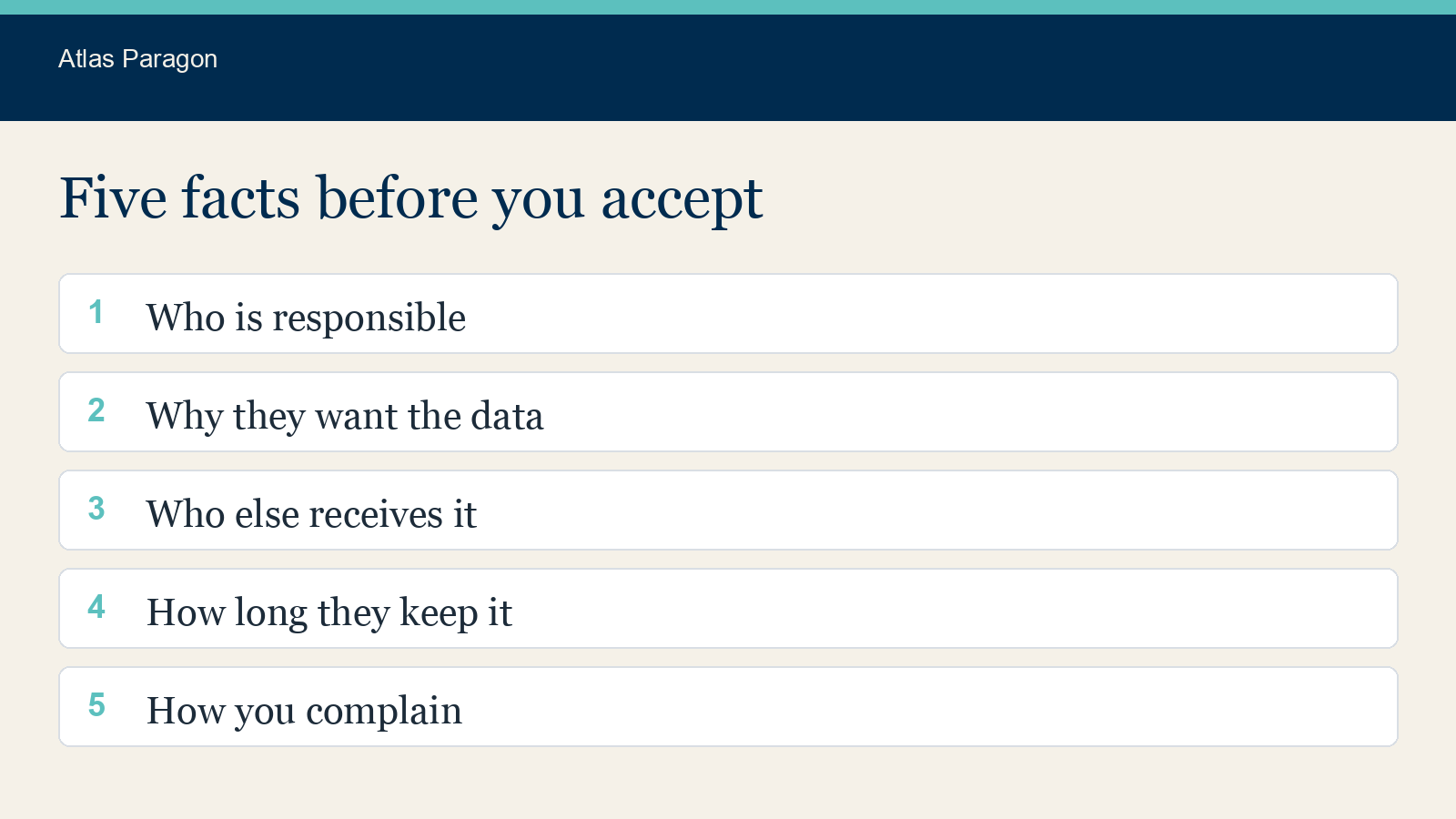
The five facts
The ICO’s guidance on the right to be informed is the standard for what a privacy notice has to tell a person. When you are the person reading one, look for these and stop:
- Who is responsible. A company name and a way to contact them, not “we” and a logo.
- Why they want the data. A purpose you can repeat in one sentence. “To improve our services” is not a purpose.
- Who else receives it. Advertisers, group companies, and processors should be named or described, not hidden behind “trusted partners”.
- How long they keep it. A period, or the rule they use to decide. “As long as necessary” with no rule is a gap.
- What you can ask for. Access, correction, deletion, and how to complain to the ICO. If the page never mentions a complaint route, it is incomplete.
Where people get caught
The banner is not the notice. A cookie banner that only offers Accept, or that pre-ticks optional boxes, is a separate problem from the privacy page. Read the page the banner links to. If that link is missing, you are being asked to agree to a document you cannot open.
Look at the date at the top or the bottom. A notice updated years ago, on a product that has added payments or location since, is describing a different product. Treat the mismatch as a reason to hesitate, not as a reason to assume the old text still covers you.
Shared devices matter. If you click Accept on a household tablet, you may be agreeing for everyone who uses it. Read it on a device that is actually yours when the decision is about an account, a payment, or a health app.
What to do when the five facts are missing
Do not invent a legal conclusion from a missing paragraph. Do the practical thing. Do not create the account, do not connect the payment card, and do not upload photos, until the page answers who, why, who else, how long, and how you complain. If you already have an account, use the contact on the page and ask for the missing piece in writing.
If you are the person writing a notice, rather than reading one, that is a different job: privacy notice basics.